
Each email gives a name, a workplace and a favourite fruit, and asks what we can make for them.
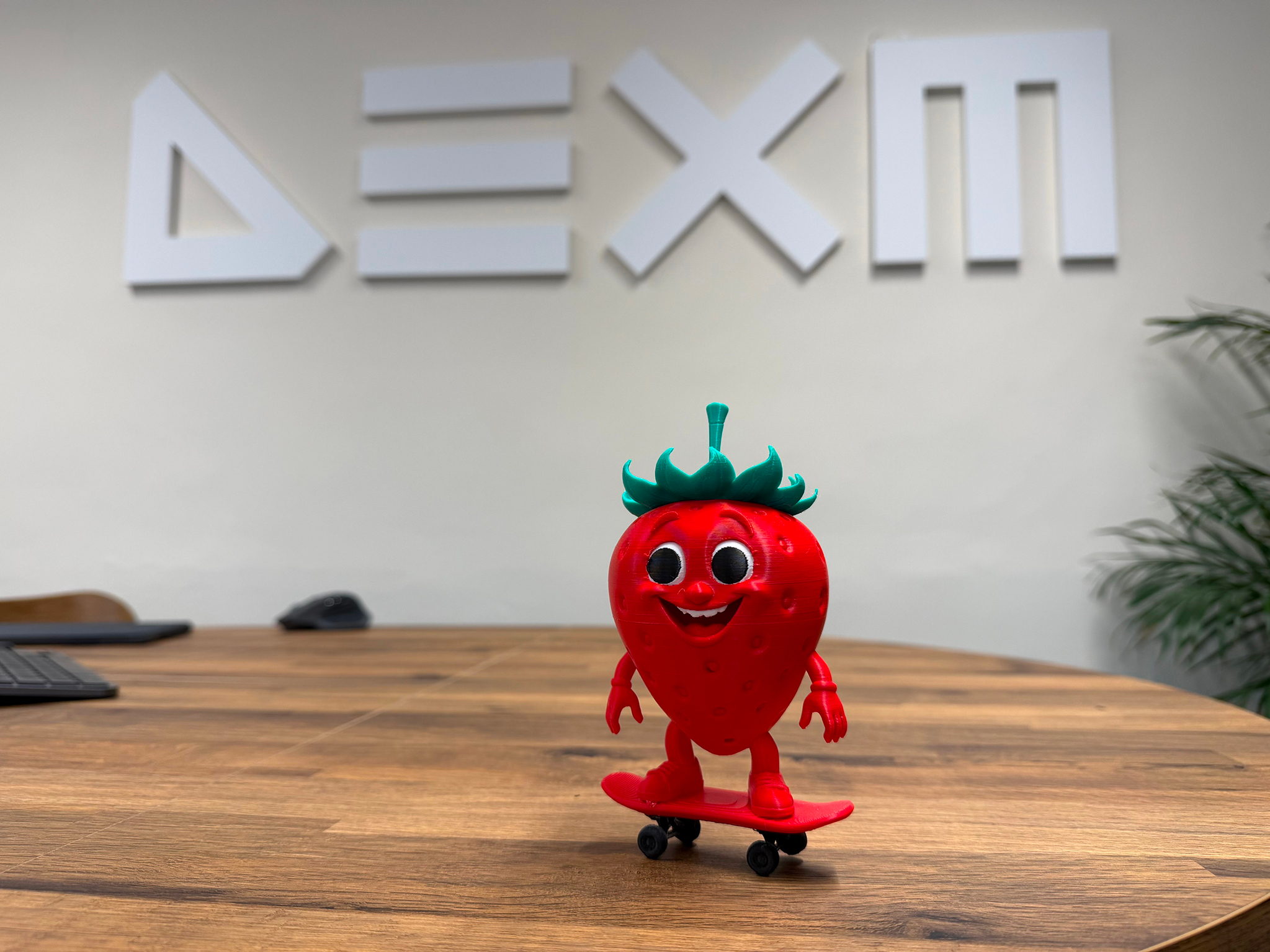
A few minutes later, an email comes back with a link to a website made just for them. On it is a smoothie recipe invented around their fruit and a character to go with it. One strawberry fan recently got Sunny the Strawberry Swirl, a pink and red swirl with a leafy green crown who gets about on a shiny red skateboard. Sunny stars in his own 15-second film, and the process also turns him into a 3D model you can spin around on the page. Further down, the site has slotted the order into the day's delivery run with a planned arrival time.
Behind all of that, the same process has added the recipe to a combined shopping list with estimated supplier prices and updated a live profit and loss for the whole imaginary business.
Nobody touched any of it in between.
It's deliberately a bit silly, and we wouldn't be the geeks we are if we hadn't printed a 3D Sunny to bring along as well. The idea behind it applies to almost any business.
Most AI still needs someone sitting with it
When most people picture using AI at work, they picture a conversation. You type a question, it answers, you read the answer, fix the bits that aren't right and paste it into whatever you were actually working on. Then you do it again.
That's genuinely useful, and the tools behind it keep getting better. MCPs let models reach into other applications and data. Agents can take a goal, plan their own steps and go off and carry them out. Both can do remarkable things, and we use them.
Every one of those interactions still has a person in the middle. Someone has to start it, check it and carry the result to wherever it needs to go next. The AI is doing a task, and the person is still doing the process.
Autonomy isn't always the answer
The obvious next step seems to be handing the whole process to an agent and letting it work out the rest. Sometimes that's right. If the problem is open-ended and nobody knows the steps in advance, giving a model room to explore makes sense.
A lot of what a business does every day looks nothing like that. An order arrives, an enquiry comes in, a new client signs. The steps are known. What matters is that they happen in the right order, to the same standard, every time.
For that kind of work, an agent choosing its own route adds risk. It's harder to predict what it will do, harder to test, and harder to explain afterwards why it did something. The freedom that makes an agent impressive in a demo is the last thing you want running your invoicing.
So the approach we've been taking goes the other way: less interaction and more control. Decide the steps. Let AI do the parts it's good at within each one. Keep the overall shape fixed.
Small steps that check their own work
Each step in the smoothie business does one job. Read the email and pull out the name and company. Look up where that company's office is. Invent a smoothie and a recipe. Describe a character and turn it into a 3D model. Write a script and make a short film from it. And so on down the line.
Inside each of those, the pattern is the same. The step takes one simple request and has to hand back one result that has been checked. It works out what's being asked, generates something, validates it, reviews it, and if it isn't right, refines the request and tries again. Only a result that passes moves on.
That matters because, as I wrote last time, there is no single AI that's good at everything. The recipe, the character, the 3D model and the film draw on different models and services with different strengths. One writes the script, for example, and another turns it into video. Models also get things wrong, sometimes with total confidence. Building the checking into every step means one bad answer can't travel down the line unnoticed and turn up on the finished website.
Joining the steps up
Once you have steps you can trust, you can start connecting them. Something triggers the process, in this case an email arriving. Logic decides what happens next. Actions run. The process branches where it needs to, and eventually there's a result.
The smoothie business runs on one email, 14 of these workflows and 90 individual actions.
Plenty of those actions involve no AI at all. They're the joins: saving each record, publishing the page, passing a customer's details from one system to the next, sending the final email. Those joins are where people normally end up copying and pasting between tabs, and they're where a surprising amount of time in any business goes. Bring them into the process and the AI steps become part of something that runs by itself, instead of separate tools someone has to visit.
Why a smoothie?
The sensible demo would have been a document parser or an email triage tool. They're useful, they're common, and they'd have shown off the same technology.
They would also only have shown AI doing one familiar task a bit faster. The smoothie business is ridiculous on purpose. No business would pay a team to design a mascot, model it in 3D, cut a video and build a website for a single smoothie order. The numbers would never add up.
That's the real point of it. Connected automation speeds up the work you already do, and it also makes room for work that was never worth doing before. Swap the smoothie for a tailored proposal, an onboarding pack built for each new client, or a costed plan produced the moment an enquiry lands, and it looks a lot less silly.
Finding the invisible work in your own business
The best candidates are usually the things that happen the same way every time something arrives: an email, a form, an order, a booking. Ask what someone does next, then what they do after that, and keep going until the work is finished.
If the answer is a list of steps that rarely changes, with a person ferrying information between systems, you've found a process that could just happen. Some of those steps might need AI. Plenty won't. The value comes from connecting them so nobody has to sit in the middle.
It's worth deciding where a person should still look at the result, too. Less interaction can still mean someone checking the output at the moment it matters, so their time goes on the decisions that need them and the rest takes care of itself.
The best automation is usually the kind nobody notices. Nobody chats to it, prompts it or has to remember to run it. Something arrives, the work gets done, and the result turns up where it should.
The fruit was fun. The invisible automation is the point.